The Logic Trap


I am a fan of data. I like spreadsheets. I find comfort in the brutal honesty of a pathology report. When life feels chaotic, I retreat to numbers because numbers don’t offer platitudes. They don't tell you to "just relax." They just tell you the count.
So, naturally, I loved Daniel Finlay’s recent article in Cheek Media.
Daniel is a philosopher. He outlines his decision to have a vasectomy at 30 not as a whim, but with the precision of a structural engineer. He doesn’t talk about "vibes" or "feeling ready." He cites "consequentialism." He references specific studies on regret rates—noting that only 7% of childfree men experience regret, compared to studies showing up to 13% of parents who say they would not have children if they had a do-over. He has a developed framework regarding the ethics of suffering, climate change, and the foster care system.
He brought receipts. Literally. He has done the math on his life.
And yet, when he presents this meticulously architected life plan to society, the response isn't a respectful nod to his logic. The response is... vibes.
- "You'll change your mind!"
- "But what about a mini-you?"
- "It's different when it's your own!"
- "Who will look after you when you’re old?"
Reading his piece, I recognised the dynamic immediately. It is the Logic Trap.
We (the involuntary) and Daniel (the voluntary) are seemingly opposites. He spent $500 to shut down a fully operational factory because he wanted to focus on ethics and reducing suffering. I spent the GDP of a small island nation trying to coax a single viable sperm into existence like it was a panda in captivity.
He locked the door. We had the door slammed on our fingers.
But we are both making life decisions based on hard data.
We have tracked cycles, measured follicle sizes in millimetres, and calculated the statistical probability of a live birth down to a decimal point. We know the exact odds of a TESA extraction success (low) versus the odds of a fresh transfer working (variable). We have spreadsheets that track medication dosages against hormone levels.
Daniel has calculated the ethical weight of bringing a life into a climate crisis. He has weighed the resources required to raise a biological child against the resources he could use to foster existing children or support his community.
We are the only ones doing the math.
And we are constantly being shouted at by people who are doing poetry.
You tell someone, "I have zero sperm count due to a medical condition." They reply, "Miracles happen! My cousin’s neighbour ate a pineapple core and got pregnant instantly."
Daniel tells someone, "I have an ethical objection to increasing suffering and the data shows I am unlikely to regret this." They reply, "But babies are cute! You don't know real love until you're a parent!"
It is like bringing a scientific calculator to a séance. You cannot use logic to argue someone out of a position they didn't use logic to get into.
The issue isn't that our math is wrong. The issue is that society operates on The Script.
The Script says: You grow up. You get a job. You partner up. You reproduce. You pass the baton.
It is a momentum-based system. It doesn't require thought; it just requires compliance. It is a runaway train, and the passengers get very nervous when they see someone standing calmly on the platform, checking the timetable and deciding not to board.
When Daniel presents his reasons, he isn't just making a personal choice; he is threatening the validity of The Script. If he can choose not to have children and be happy, ethical, and purposeful, it suggests that parenthood isn't the only path to a meaningful life. And for people who never questioned The Script, that is a terrifying proposition.
Similarly, when we present our medical reality—that biology sometimes just fails—it threatens the "Just World" fallacy. People want to believe that if you want kids and are "good people," you get kids. The universe is random and unfair (or maybe fair, depending on how you look at it). That makes people uncomfortable. So they try to "fix" it with toxic positivity and stories about miracles.
Daniel’s article highlights the absurdity of this collision. It shows that the intrusive questions—the "Bingo Card"—aren't really about fertility at all.
If you are infertile, people tell you to "just relax" or "adopt." If you are childfree by choice, people tell you "you'll change your mind" or "you're selfish."
The stimulus is different, but the response is identical. It is the collective panic society feels when someone steps off the conveyor belt.
It turns out, it doesn't matter why you stepped off. It doesn't matter if you opted out (like Daniel) or were forced out (like us). The crowd yells the exact same thing: "Get back on the belt! You're going the wrong way!"
There is a weird solidarity in realising this. It means the "Childfree" and the "Childless" aren't enemies. We are allies in the war against awkward small talk. We are both standing on the platform, holding our data, watching the train leave the station.
He talks about finding purpose in "reducing suffering" and fostering community. That is his "Third Thing."
I highly recommend reading Daniel’s piece. It is a masterclass in rationality. It is a relief to see someone else using a spreadsheet to navigate a world that runs on vibes.
Just don't expect his logic to work on your aunt at Christmas. When she asks "Who will look after you when you're old?", she isn't asking for a retirement plan analysis. She's asking you to get back on the train.
Read the full breakdown of the math at Cheek Media
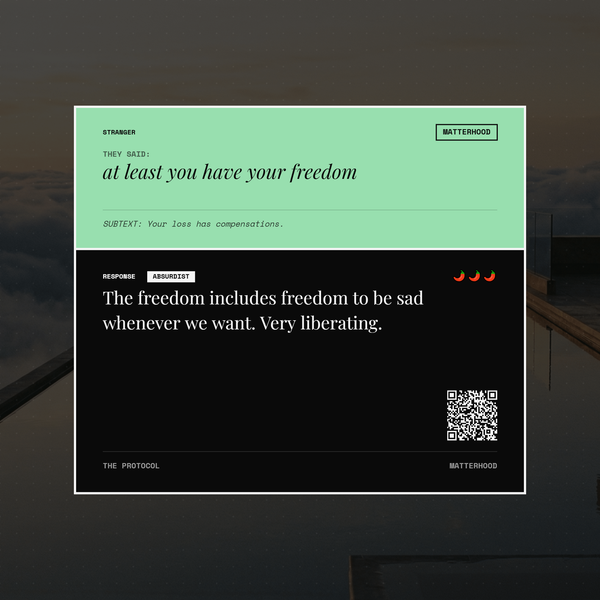
If logic fails, use The Protocol